Why Your Content Gets Reach One Week and Dies the Next
A post can get strong reach one week and almost no attention the next. That doesn't always mean your content has become worse. Topic selection, audience interest, timing, format, engagement and consistency can all affect how people respond to your content. This blog explains why content performance changes and how businesses can use simple data and patterns to build a more consistent content strategy.
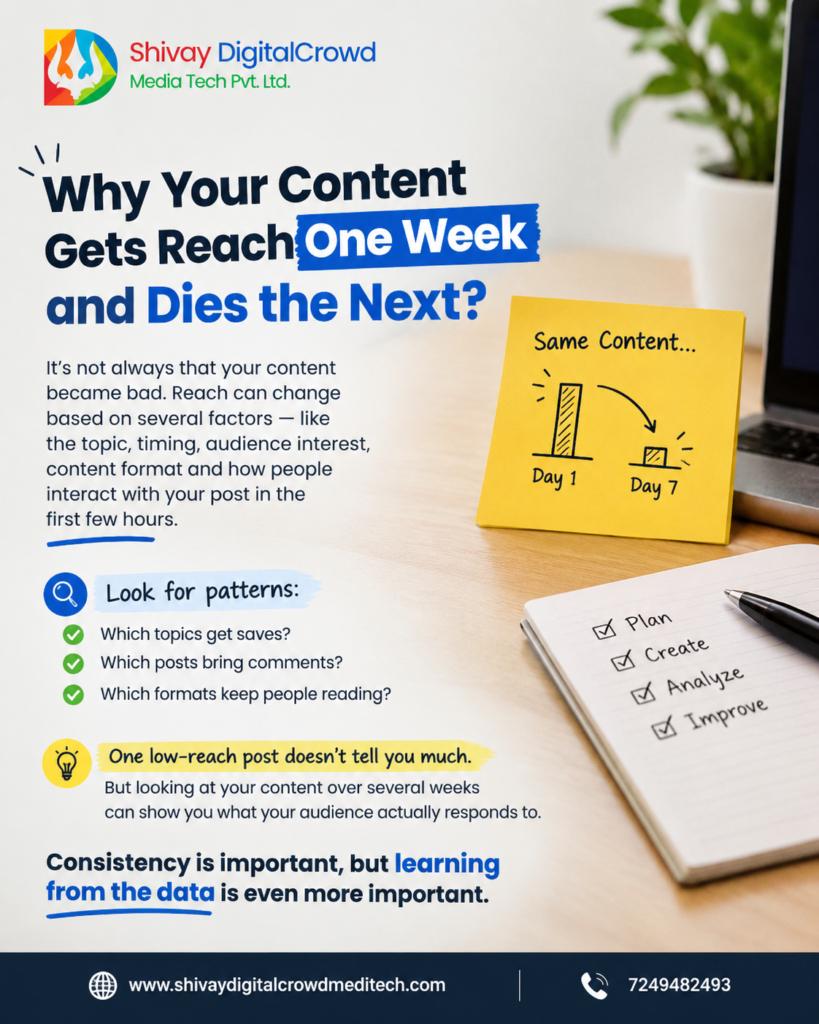
Why Your Content Gets Reach One Week and Dies the Next
You post something on Monday and suddenly the numbers look great.
More people are seeing it.
People are commenting.
Some are even sharing and saving it.
Then you post something similar a few days later, and the response is completely different.
Very little reach.
Few interactions.
And you start wondering, “What happened?”
This is a common situation for businesses and creators.
The first thing to understand is that one low-performing post does not mean your content strategy is failing.
Reach Can Change for Many Reasons
Content performance is affected by several things at the same time.
The topic you choose matters.
The timing of the post matters.
Your audience’s current interests matter.
The format you use matters.
Even the way people respond to your content shortly after it is published can influence how far it travels.
This is why comparing one post with another isn’t always useful.
Instead, look at your content over a longer period.
Don’t Judge Your Content Too Quickly
One of the biggest mistakes businesses make is judging a post within a few hours.
A post may start slowly and pick up later.
Another post may get strong initial reach but stop growing quickly.
Instead of asking, “Why didn’t this post perform?” every time, look for patterns across several posts.
Which topics regularly get attention?
Which posts receive saves?
Which ones generate meaningful comments?
Which formats keep people reading?
These patterns can tell you much more than a single post.
Your Audience May Not Want the Same Thing Every Day
Imagine you normally share educational content about marketing.
One day you post about a problem your audience deals with every week.
The next day, you share something that is technically useful but less relevant to their immediate needs.
Both posts may be well-written.
But the audience response can still be very different.
Good content isn’t only about quality.
It is also about relevance.
Understanding what your audience actually wants to learn, solve or understand can make your content much more useful.
Don’t Change Your Entire Strategy After One Bad Post
This happens often.
One post gets low reach, so the business changes the posting time.
Another post performs poorly, so they change the content style.
A few days later, they try a completely different topic.
Eventually, there is no clear strategy left.
Instead, make smaller changes.
Test different topics.
Try different formats.
Experiment with hooks.
Observe the response.
Then keep what works and improve what doesn’t.
Look Beyond Likes
Likes are easy to notice, but they don’t tell the complete story.
A useful post may receive fewer likes but generate saves, shares, profile visits or meaningful conversations.
That is why businesses should look at multiple signals when evaluating content.
The goal isn’t to make every post go viral.
The goal is to understand what creates value for your audience.
This is where a good Digital Marketing Agency in Pune can help businesses look at content performance from a broader perspective, rather than focusing only on vanity numbers.
Consistency Still Matters
Consistency doesn’t mean publishing something every single day without a plan.
It means showing up regularly with a clear purpose.
Whether your strategy includes digital marketing services, seo services, social media marketing services, or regular content creation, the same principle applies.
Create.
Measure.
Learn.
Improve.
Repeat.
Your content will not perform exactly the same way every week.
That’s normal.
What matters is whether you are learning from the results instead of reacting to every small change.
One low-reach post doesn’t define your content. The patterns you discover over time can help you create much better content.