Why Changing Your Marketing Strategy Too Quickly Can Hurt Your Business Growth
A marketing campaign that doesn’t deliver results in the first few weeks doesn’t always mean the strategy is wrong. Marketing needs time, consistency, and enough data to reveal what is actually working. Learn how to identify the real problem, test changes carefully, and build a marketing strategy that delivers sustainable business growth.
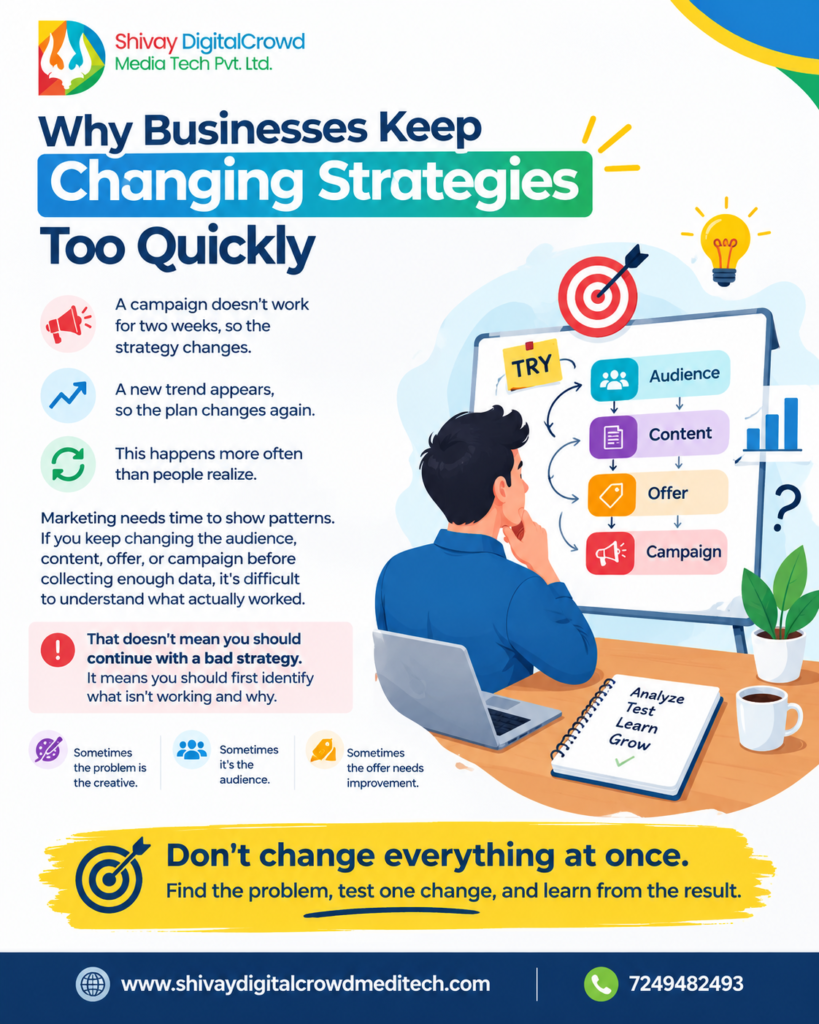
Why Businesses Keep Changing Strategies Too Quickly
One of the most common mistakes businesses make with marketing is changing direction too quickly.
A campaign runs for a week or two.
The expected results don’t come.
The strategy is immediately changed.
Then a new trend appears on Instagram.
The content plan changes again.
A competitor launches something different.
The offer changes.
Before long, the business is trying several different approaches without knowing which one actually worked.
This situation is especially common for businesses working with a Digital Marketing Agency in Pune, where the digital space moves quickly and businesses are constantly exposed to new trends, platforms, and marketing ideas.
But moving quickly and changing everything quickly are two different things.
Marketing Needs Time to Show Patterns
Not every marketing campaign produces immediate results.
Some campaigns need time to reach the right audience.
Some require multiple interactions before a potential customer decides to take action.
Search visibility can take even longer to develop, while social media content may need consistent publishing before clear engagement patterns become visible.
This is why digital marketing services should not be judged only by a few days of performance.
Instead, businesses should look at meaningful data over a reasonable period.
Are people clicking?
Are they engaging with the content?
Are enquiries increasing?
Is the right audience responding?
Are visitors taking the desired action?
These questions provide much more useful information than simply asking, “Why didn’t we get results this week?”
Find the Real Problem First
When a campaign underperforms, the answer isn’t always to replace the entire strategy.
The problem could be the creative.
Maybe the message isn’t clear enough.
Maybe the audience being targeted isn’t the right one.
Maybe the offer doesn’t give people enough reason to take action.
Sometimes even a good campaign can struggle because the landing page or customer journey needs improvement.
For example, a business might receive plenty of website visitors but very few enquiries. In that situation, changing the entire marketing strategy may not solve the problem. The issue could be the website experience or the way the offer is presented.
The same principle applies to SEO services. If a website is not ranking immediately, constantly changing keywords, pages, and content without understanding the reason can make the process more confusing rather than more effective.
Don’t Change Everything at Once
One of the simplest ways to improve marketing decisions is to change one important element at a time.
Suppose an advertisement is receiving clicks but very few enquiries.
Instead of changing the audience, creative, budget, offer, and landing page together, start with one variable.
Test a different message.
Observe the result.
Then make the next improvement.
This approach makes it easier to understand what influenced the performance.
The same applies to social media marketing services.
If a particular type of content is getting better engagement, study why people are responding to it before completely changing the content direction.
Trends Are Useful, But They Need Context
New trends can create opportunities, but businesses should not follow every trend simply because everyone else is doing it.
A trend may work extremely well for one brand and have almost no impact on another.
Your audience, industry, pricing, brand personality, and business goals are different.
The goal should not be to copy what is popular.
The goal should be to understand what is relevant to your customers.
Good content creation is not about producing something new every day just to stay active. It is about creating useful, relevant content that supports a clear business objective.
Test, Learn, Improve
Successful marketing is rarely about finding a perfect strategy on the first attempt.
It is usually a process of testing, learning, and improving.
A campaign may reveal that the audience needs to be refined.
A piece of content may show that customers respond better to a particular message.
An offer may need to be presented differently.
Each result provides information for the next decision.
Instead of asking, “Should we change the strategy?” ask, “What is the data telling us?”
That small change in thinking can make marketing decisions more practical and less emotional.
Final Thoughts
Changing a strategy is sometimes necessary.
But changing everything before understanding the problem can make it almost impossible to know what worked.
Give your marketing enough time to generate useful data.
Identify the weakest part of the campaign.
Test one change.
Measure the result.
Then improve.
Don’t change everything at once. Find the problem, test one change, and learn from the result.
That is how businesses can move from constantly trying new strategies to building a marketing system that improves with every campaign.