Why Your Best Content May Not Be Your Most Popular Content
High reach can make a post look successful, but views alone do not show whether content actually helped people. Learn why useful content can outperform popular content in trust, engagement, and long-term value.
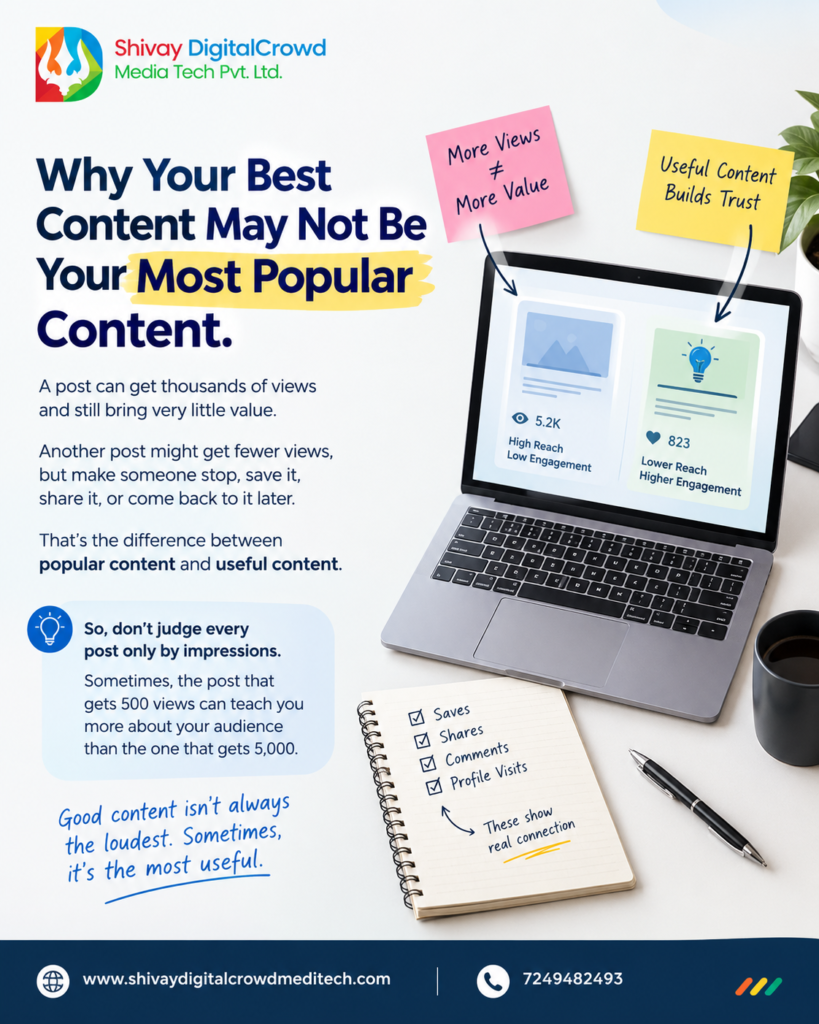
A post gets 5,000 views, another gets 500. At first glance, the first post looks like the clear winner. But what if the second one was saved 80 times, shared with colleagues, and brought several people back to the website?
This is where content performance becomes more interesting.
Popularity and usefulness are not always the same thing.
When people talk about content performance, they often focus on impressions, likes, and reach. These numbers are useful, but they only show part of the picture. They tell you how many people saw something or interacted with it. They do not always tell you what people learned, remembered, or did afterwards.
Think about the last useful post you saved on LinkedIn or Instagram. You may not have liked it. You may not have commented. But you saved it because you knew the information could help you later.
That is valuable engagement too.
Good content often solves a small problem. It answers a question, explains something clearly, shares a practical idea, or helps someone avoid a mistake. It does not need to become viral to be useful.
For businesses, this distinction matters even more.
A company can spend time creating content that gets attention but says very little. Another company can publish simple educational posts that reach fewer people but consistently build trust with the right audience. Over time, that trust can become more meaningful than a temporary spike in views.
This is one reason a Digital Marketing Agency in Pune should look beyond surface-level numbers when evaluating content. The goal should not be to chase every high impression count. It should be to understand what kind of content creates genuine interest and useful interactions.
The same thinking applies to digital marketing services. Different audiences respond to different formats. A quick tip may get shares, while a detailed guide may get saves. A strong opinion may generate comments, while a practical checklist may bring profile visits.
There is no single metric that tells the whole story.
For example, SEO services may bring visitors through search, but the real question is what those visitors do after arriving. Do they find the answer they wanted? Do they explore another page? Do they return later? Traffic is only the beginning.
Social media works in a similar way. Social media marketing services should not be measured only by follower counts. A smaller audience that actively reads, saves, shares, and discusses your content can be more meaningful than a large audience that scrolls past everything.
Content creation should therefore start with a simple question: “What will the reader get from this?”
Before publishing, ask whether the post teaches something, makes a complicated idea easier, answers a real question, or gives the reader something they can actually use.
Then look at the numbers, but look at them together.
Reach tells you how far the content travelled. Saves can show future usefulness. Shares can indicate that someone found it worth passing on. Comments can reveal whether the topic created a real conversation. Profile visits can show whether the content created enough interest to learn more.
Useful content can also have a longer life. People may discover it days later, save it for a future need, or share it when that question comes up.
The best-performing content is not always the content with the biggest number on the screen.
Sometimes, the most valuable post is the one that quietly helps the right person.
That is why content strategy should focus on creating value first and chasing reach second.
Because popular content gets attention.
Useful content gives people a reason to remember you.